Tuesday, 14 June 2011

My Most Important Games Ever - Part IV

Part III can be read here.


First up something slightly obscure from the 8-bit era.  The standard for the football management genre at this time was, not totally surprisingly, Football Manager.  It was pretty much the first game of its kind and many at the time thought it was the best 8-bit football management game of them all.  But they were wrong.  Because Advanced Soccer Simulator was better.  Better graphics, better sound and a tougher learning curve, with quicker gameplay (i.e no pauses to calculate the league table) and the ability for 8 players to play in hotseat mode.  The game came out q while after Football Manager, at the arse-end of the 80s which probably helps explain why it was so overlooked.  Sound consisted of pleasant bips and beeps when a key is pressed or the ball is kicked, and when a goal is scored (or missed) during the highlights sequence the sound seems to be a variety of bird-calls, which is simultaneously odd and brilliant.  The goal nets and ball are fantastically drawn and the crowd in the stands is animated.  Also a bit strangely, English and Scottish teams are mixed together in the same four-division pyramid.  Pitch colour was selectable from 7 options and you start out at the bottom of the league pyramid whichever team you choose to play as.  Grab an emulator and have a go.


Next is quite possibly the first Spectrum game I ever played.  Witchfiend came free with the machine and it wasn’t a complicated game.  It probably wasn’t even that good.  It did have lovely sound.  But along with the other free games (mainly Treasure Island and Punchy; more in a minute) it defined my first few months of owning a Spectrum.  It’s a pretty basic go-from-screen-to-screen-collecting-stuff-while-avoiding-monsters-and-obstacles kind of thing, although playing it now I wonder how the king ever managed to get around his palace.  Presumably everyone in this universe has the power of flight.
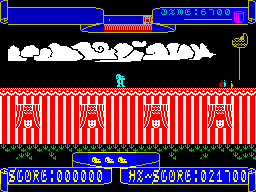


As for Punchy, that game was a grim psychedelic nightmare plucked from the darkest corner of the world’s most acid-burned imagination.  As a kid I had no idea what it was about.  The music was odd, the digitized speech was terrifying, obstacles were puzzling and the main sprite appeared to be a horrifically deformed semi-human with a death-wish and a fetish for flying sausages.  But when you were 7, trying to see what was on the next screen was compelling.


Next, onto the Amiga.  This game had a massive impact on me when I first saw it.  From the mind-blowing intro sequence to the brilliant graphics and animation during the game itself, Another World broke new ground in gaming.  The use of cutscenes and the cinematic gameplay have been enormously influential.  Hideo Kojima of Metal Gear Solid fame cites this game as one of his main influences.  It plays like an interactive movie and for the time it looks breathtaking.  The mix of platform action and puzzles kept the game interesting, although trial and error could sometimes be necessary.  The multifunctional weapon was a real innovation.  The game screen is intentionally Spartan, with no HUD at all.  The idea here is immersion, tension and atmosphere, and all the more impressive that the game was conceived, designed and programmed by one man.  The game might be a bit short but it’s a good challenge.  Play the Amiga version – you won’t be disappointed.


Next for the Amiga is probably the granddaddy of all modern football management games, Championship Manager ’93.  It’s difficult to overstate the importance of this game to the genre.  The first game in the series, just prior to this one, seemed to be stuck between worlds – not quite as basic as the 8-bit games before it, but not quite as detailed and polished as some 16-bit contemporaries.  Thisgame, however, saw that change, bringing real player names, the Premier League and foreign players into the mix, and for realism and challenge, contemporaries were left floundering on the ground like Titus Bramble.  It was by far the best game of its kind around at the time and it still holds up today.  For me, the game delivered on the promise of an earlier title: Tracksuit Manager by Goliath Games.  I think there’s a clear influence there, especially with the text commentary during the match.  After this game, the competition were always trying to catch up and they never quite managed it.  This game started a dynasty that has lasted almost two decades and is still going strong.

N.B.  Modern Championship Manager titles aren’t related to this series.  Following a split with Eidos, Sports Interactive took their game and renamed it Football Manager.


Finally for this part is another Amiga classic.  Displaying Sensible Software’s special sense of humour and uncanny ability to make wickedly playable games, Cannon Fodder is simultaneously ridiculous and very smart.  Much too smart for the media of the time, who were outraged by the game’s over the top comic violence and seemingly casual attitude to war, all clearly satirical.  The game’s sense of humour can be a bit dark; the main screen is a grassy hill with gravestones representing each soldier you’ve lost, while a queue of new recruits lines up in front of it, and total casualties are listed like a football score at the top (HOME : AWAY).  The game’s music is fantastic, going from ridiculous to poignant and back again several times.  Each individual soldier has a name and this makes you genuinely care about their survival – losing one can be a moving experience when the casualty list is shown after each mission.  Graphically the game looks great, sharing a style with Sensible Soccer and Powermonger, and it’s wildly addictive.  One of the best games on the Amiga.  Ever.

Friday, 3 June 2011

My Most Important Games Ever - Part III

Part II of the series is available to view here.


The first game of part 3 is a Commodore 64 classic.  Uridium is a side-scrolling space-based shooter.  The graphics are beautifully drawn and the main ship sprite’s animation is brilliant, but what really sticks out for me and takes me right back to being 6 again, and sitting in front of an old beige and fake wood portable and the breadbox C64 at my nan’s is the simply stunning title music.  It’s so good I could cry.  It still sounds fresh today.  The C64’s SID chip was a marvel back then and nothing has ever sounded like it.  Sound, and especially music, were just unique on the C64.  I think truly creative original music for computer games is something that’s being lost as studios cram more and more licensed or professional studio-recorded tracks onto their DVDs and Blu-Rays.  I’ll probably do a bit on game music at some point in the future…


I’m torn on the next game as to whether my fondest memories of it are from the C64 version or the Spectrum version.  I played the C64 version of Barry McGuigan World Championship Boxing before the Speccy version.  I loved the colourful graphics and the ability to customize your boxer’s race, hair colour, shorts and gloves colour, as well as their boxing style and personality.  Using your created boxer, you worked your way up the world rankings to take on McGuigan himself.  I got the Spectrum version for Christmas during the late 80s after the Mastertronic rerelease.  The graphics and sound weren’t as good on the Speccy but the gameplay was still great.  It was a good challenge too.  There were 19 boxers to face in all, each with their own style and attributes, and some of them could be a right bastard to get past.  But the satisfaction when you finally beat them made the hard work worth it.  It was a bit of a shame though that when you finally beat Barry himself and became the champ you could only defend the belt against Barry.  Ad nauseam.  Until you topped his $13 million in prize money, which I never had the patience for.  Fights were atmospheric, with an arena full of people, including camera flashes, and between rounds you were given an idea of the level of excitement among the spectators.  It was simply the best boxing game around.  I don’t think it was topped until the fairly recent release of the Fight Night series.  Get an emulator and play it.


The next game is very, very special.  I first saw it on my cousin’s Amiga.  I thought the name was a bit stupid.  Sensible Soccer?  What did that mean?  Then I saw how many teams there were.  Something like 64 European club teams.  A load of national teams.  And a load of custom teams, some with brilliantly humorous names.  And the kits could have stripes?  Or hoops?  Or sleeves, like Arsenal?  Brilliant.  And it was all editable?  Then the match started and something hit me: football games had changed forever.  This was a watershed moment in the history of gaming.  There was nothing really like this.  Kick-Off was like chickens on a pinball table.  Emlyn Hughes was great, but it was slow and there weren’t many teams.  But this was quick, intuitive, and wickedly playable.  And it looked great.  The cartoony players took a bit of getting used to but the pitch looked fantastic.  Sliding tackles, diving headers, mad curling shots were all here and all easy to perform, yet hard enough to master that it kept you coming back.  You could play a fast, possession-based passing game and it was a joy.  The matches had real atmosphere and a real tension if there was only a goal in it.  And to top it all off, the music (by none other than Captain Sensible) is just brilliant.  From the excellent title music as the opening credits rolled to the memorable menu music which takes me right back to spending hours in front of my uncle’s Amiga before I got my own.  The game spawned a host of mostly rubbish clones, and several titles were added to the series, culminating in the release of Sensible World of Soccer, which is now available to play again on XBOX Live Arcade.  It’s well worth getting.


Next up is another bona-fide Amiga classic that was expected to change the world but never quite managed it.  It was, however, very influential (see Team 17’s Worms).  Lemmings is a work of genius by DMA Design, now known as Rockstar North of Grand Theft Auto fame.  Graphically it’s not much to write home about but it does the job.  Sound is sparse but pleasing and the music is pretty decent with good variety between levels.  But the real strength of the game is the addictive gameplay.  The basic idea was to save as many lemmings as possible as they made their suicidal way across various hazardous levels.  To do this you were provided with a limited number of special roles you can assign to individual lemmings, from “Builders” to “Blockers” to “Climbers and so on.  You had to use the appropriate role at the appropriate time to interact either with the environment or with other lemmings.  For example, you would use the Builder to build a bridge over a chasm which your lemmings would otherwise walk blindly into.  A Blocker would stop other lemmings from passing and force them to turn around.  Using these ideas you would guide your lemmings towards an exit door at a specific point in the level.  At first it’s a serene and only mildly taxing experience.  Later levels do require some thought and planning but as everything is against the clock, panic could set in and you shouldn’t take too long.  All your lemmings explode when the time runs out.  I can only really recommend the Amiga version.  The Atari ST and PC versions are inferior in just about every way.  Just grab WinUAE and the game ROM and have a go.


Computer games are stupid aren’t they?  Little wastes of time for snotty-nosed kids to gawk at when they should be doing their homework or weeding the garden or sewing Nike Air Max for a dollar a day.  The little shits.  Well it’s a bit more complicated than that.  There are lots of games, lots of variety.  So some will be horseshit.  But some will be good.  Some are mindless bollocks (50 Cent: Blood on the Sand anyone), and some tax the brain a bit (see above).  Some developers couldn’t give a shit about history.  Sometimes it’s not applicable.  But some developers like history.  Some even include it in their games.  And history is a key thing for the next game.  Knights of the Sky is a pretty simple World War I flight-sim.  You begin as a green pilot in the Royal Flying Corps in 1916 and fly missions between then and winter 1918.  Combat patrols, bombing, balloon-busting, all are here.  As are real World War I aces like Manfred and Lothar von Richthofen, Max Immelmann, Rene Fonck, Charles Nungesser and Albert Ball.  And you could meet up with some of them in the air.  Or once you joined their illustrious company you could issue them with challenges (just the Germans though, you didn’t want to kill your own side).  The game is hugely atmospheric and this is in part down to the authentic World War I game world, with the Western Front mapped accurately.  And this game proved particularly useful for me.  I used the game to help write a history essay when I was at school and it allowed me to provide a level of detail and authenticity that went beyond what the school curriculum had taught us.  I knew the geography of the Western Front and could include that, all thanks to this game.  And the essay was basically just an account of a short time playing this game, with any reference to the fact it was a game omitted.  Graphically it’s showing its age.  It wasn’t the best on the market at the time.  But the graphics do their job alright.  Sound is excellent and suitably atmospheric.  And as with most classic games the title music is superb; a very catchy period piano piece.  Music is also present sporadically in the game.  If you can get hold of WinUAE, play it.  The MS-DOS version is also excellent and should be playable in DOSBox. Here’s a video of the game in action on the Amiga.


All the way back now to the early 80s for another football game, one that I’ve mentioned once today already.  Every version of Emlyn Hughes International Soccer I’ve played (Spectrum, C64 and Amiga) is brilliant but I’ll focus on the original one, the C64 version.  The game is a true classic and probably the best C64 football action game there was.  It was clearly designed as the thinking gamer’s football game and it set the standard for the genre for several years afterwards.  There was nothing like it at the time for complexity of gameplay, probably until the first Playstation console featured ISS and FIFA.  The game features an enormous array of options to tailor your game, including 10 difficulty levels, whether or not to include backheels, and up to 5 kick directions so you could play the ball in directions other than the one your player was facing.  This was ideal for cross-field passes, crosses and angled shots.  Once mastered this makes the game hugely enjoyable.  Graphically it wasn’t a huge leap forward and sound during the match is limited to the odd airhorn or whistle or crowd sound during goalmouth action.  The menu music, however, is hugely memorable and very catchy.  The menus themselves take their inspiration from 80s computer operating environments such as Workbench, with a moveable mouse cursor and a toolbar with drop-down menus.  Eight teams are available in all and all are fully editable (team names, player names and abilities, kit colours), as is the match environment.  Pitch colour, line colour and ball colour are all selectable.  Playing with an orange ball was a particular favourite of mine.  The game still had an active online community as of 2009 and it’s simply the best of its kind for the C64.


Part 4 can be read here.